Word of the Day: Monday, October 12, 2026
Word of the Day from the article of October 12, 2026
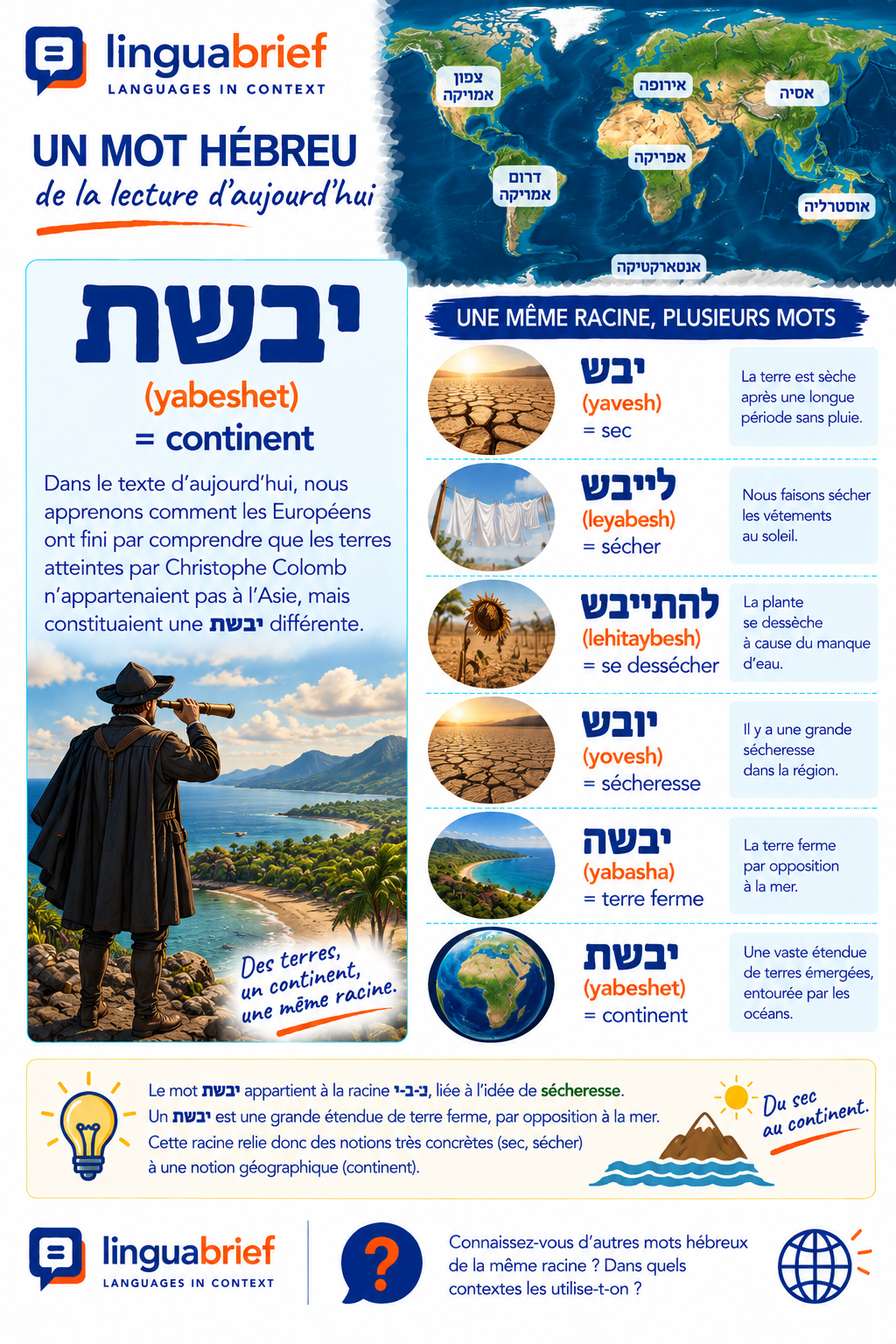
A Hebrew word from today’s reading: יבשת (yabeshet) — continent.
In today’s article, we learn how Europeans realized that the lands reached by Christopher Columbus weren’t part of Asia, but a different continent entirely.
But why does Hebrew use the word יבשת for a continent?
The answer is in its root: י־ב־ש (Y-B-Sh).
This root expresses the idea of dryness.
Here are some words in this family:
• יבש (yavesh) — dry
• לייבש (leyabesh) — to dry something
• להתייבש (lehitaybesh) — to become dry, to dehydrate
• יובש (yovesh) — dryness
• יבשה (yabasha) — dry land
• יבשת (yabeshet) — continent
The connection becomes clearer when you look at the word יבשה, which means dry land, as opposed to the sea.
In the biblical Creation story (Genesis 1:9–10), the waters gather and dry land appears.
The Hebrew word used is יבשה.
In modern Hebrew, יבשת refers to a continent—an expanse of land above water.
The semantic evolution is quite natural:
Dry → dry land → continent.
Here’s a useful distinction to remember:
יבשה = dry land, as opposed to water.
יבשת = a continent, in the geographic sense.
One root, two geographic ideas, and a link all the way back to Biblical Hebrew.
Did you know that the Hebrew word for “continent” is in the same family as “dry”?