Word of the Day for Monday, October 5, 2026 – נוסעים (Nos'im)
The Hebrew word נוסעים and how it switches between meaning 'passengers' and 'they are traveling.'
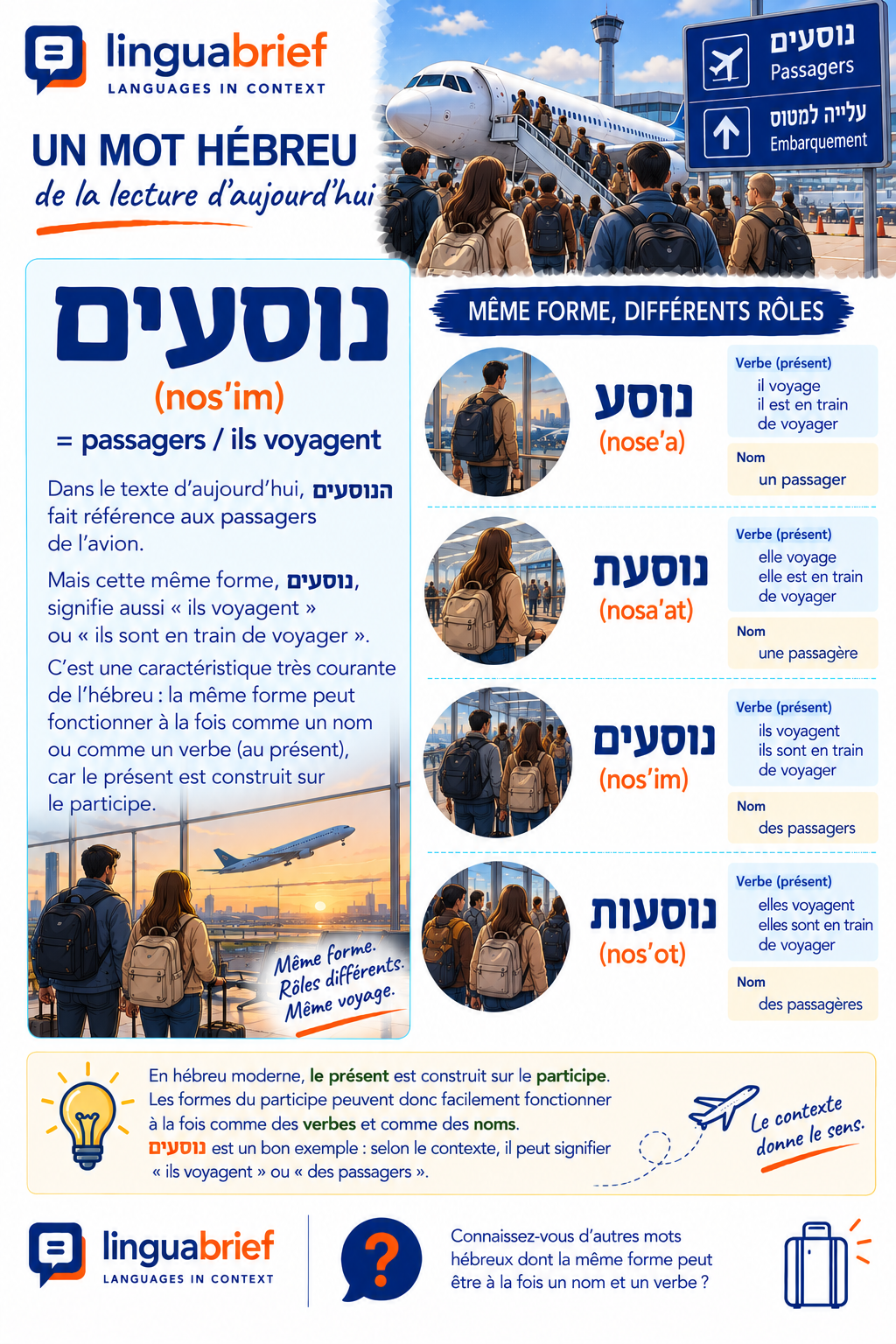
A Hebrew word from today’s reading: נוסעים (nos'im).
In the text, הנוסעים means “the passengers.”
But here’s what’s interesting: נוסעים can also mean “they are traveling” or “they travel.”
Same word. Same spelling. Different grammatical function.
Why is that?
What we usually call the present tense in modern Hebrew is historically and morphologically based on the participle. And these forms can sometimes function as nouns too.
Let’s take the verb לנסוע — to travel:
נוסע (nose'a) — he travels / he is traveling
נוסעת (nosa'at) — she travels / she is traveling
נוסעים (nos'im) — they travel / they are traveling
נוסעות (nos'ot) — they (feminine) travel / they are traveling
But in another context, exactly the same forms can be nouns:
נוסע (nose'a) — a passenger
נוסעת (nosa'at) — a female passenger
נוסעים (nos'im) — passengers
נוסעות (nos'ot) — female passengers
So how do you know which one it is?
Most often, the context gives you the answer.
הנוסעים יצאו מהמטוס
→ The passengers left the plane.
הם נוסעים לישראל
→ They are traveling to Israel.
This isn’t just a little oddity found in נוסעים. It actually reveals something fundamental about how Hebrew works: the line between participle, present-tense verb, and noun is especially flexible.
That’s why the same word can sometimes seem to jump between grammatical categories without changing form.
Once you start noticing this mechanism, you’ll spot it all over in Hebrew.
Do you know another present tense form in Hebrew that can also act as a noun?