Word of the Day October 29, 2026 – מפלגה
Word of the Day October 29, 2026 – מפלגה
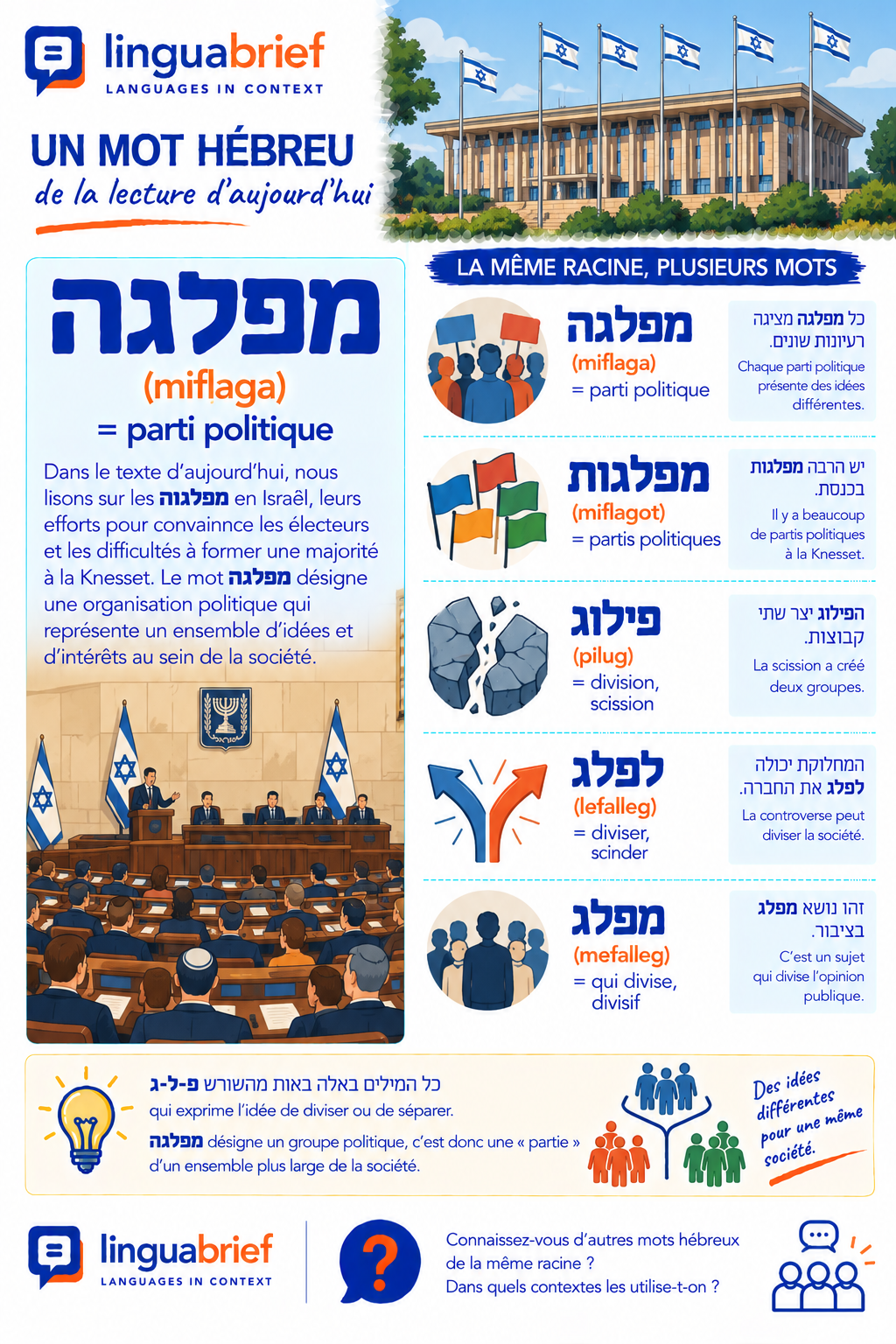
מפלגה — Why is a political party connected to the idea of division?
A Hebrew word from today's reading: מפלגה (miflaga) — political party.
Today's article discusses Israeli political parties, voting blocs, and the challenges of forming a parliamentary majority.
But the word מפלגה also has an interesting linguistic background.
It comes from the root פ־ל־ג (P-L-G), which is connected to the notion of division, separation, or splitting.
You’ll find this root in several related words:
- מפלגה (miflaga) — political party
- מפלגות (miflagot) — political parties
- פילוג (pilug) — division, split
- לפלג (lefalleg) — to divide, to split
- מפלג (mefalleg) — divider, one who divides
- פלג (peleg) — stream, brook; also "faction" or subgroup in some contexts
The link is quite clear.
A מפלגה is a political organization representing particular views or interests within a larger society.
The word פילוג, meanwhile, refers to an internal split or division, for example within a political movement.
Here are a couple of examples:
יש הרבה מפלגות בכנסת
There are many political parties in the Knesset.
הפילוג יצר שתי קבוצות
The split created two groups.
And here’s a fascinating etymological parallel with French!
The word parti in French is historically linked to partie, going back to Latin pars ("part, portion").
In English, party shares a similar story, deriving from Old French partie.
So Hebrew מפלגה, French parti, and English party all rest on the same core idea: a part of a larger whole.
They aren’t from the same linguistic origin, but each word reflects a similar way of thinking about political organization.
פ־ל־ג → פילוג → מפלגה
From division to the formation of a political party.
Sometimes, word histories reveal unexpected connections between languages.
Do you know of other Hebrew words whose political meanings spring from older, more general ideas?